Research
When Big Data Gets a Small Country Wrong
In 2015, a paper in Science ranked Sri Lanka 5th among the world's worst polluters of the ocean with mismanaged plastic waste.
That paper has since been cited more than 10,000 times. The ranking travelled everywhere: into policy documents, international media, infographics, and student presentations. For a decade, it has shaped how the world sees us and how we see ourselves.
There was one problem. The number underneath it was wrong.
The model assumed Sri Lankans generate 5.1 kg of waste per person per day. That would make us, by a wide margin, the highest waste generators on Earth, ahead of every high-income country in the dataset. Anyone who has spent time in a Sri Lankan household knows that cannot be true.
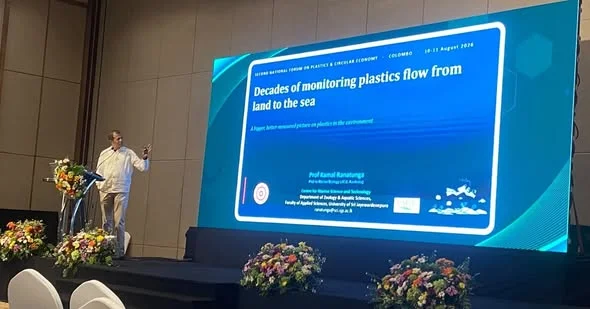
Today, at the 2nd National Forum on Plastics & Circular Economy in Colombo, I presented what our team found when we went and measured instead.
Working with colleagues at CMST and collaborators at CSIRO Australia, we showed first that human population density is a poor predictor of debris in the environment (Schuyler et al., Frontiers in Environmental Science) (Jambeck et al., 2015, has used coastal population as a proxy for mismanaged waste in the environment), and then, through empirical field surveys, that Sri Lanka's actual mismanaged plastic waste is far lower than the model predicted (Ranatunga et al., Sustainability, 2024).
Sri Lanka does not belong in 5th place. I would respectfully ask government agencies, researchers, journalists, and educators to stop citing that ranking.
But let me be equally clear about the other half of this. The threat to our coasts and marine biodiversity is real, and it is urgent. Correcting the number is not a defense of the status quo. It is an argument for policy built on measurement rather than on assumption, because you cannot manage what you have not properly counted.
Big data is powerful. When it is wrong, it is powerful in the wrong direction, and small nations are usually the ones who carry the cost.
That is why local scientific capacity matters. Not to defend a national reputation, but to make sure the evidence is right before the world builds a decade of policy on top of it.
Gallery
Related news
- Conservation

In Search of the Asoka Pethiya
Following recent floods, researchers returned to the upper Sitawaka and Kelani river systems in search of the critically endangered Asoka barb. Their observations highlight growing threats to one of Sri Lanka's most range-restricted freshwater fishes.
Read Full Article - Research
Tracing the Plastic Tide
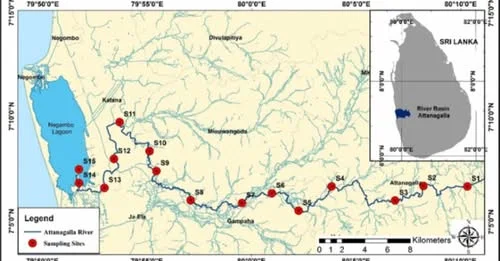
A new CMST study traced microplastics across 15 sites along the Attanagalu River, from its headwaters to the river mouth, revealing how plastic pollution moves downstream toward Sri Lanka's coastal seas.
Read Full Article - Ocean Policy
World Ocean Day 2026: From Dependence to Stewardship
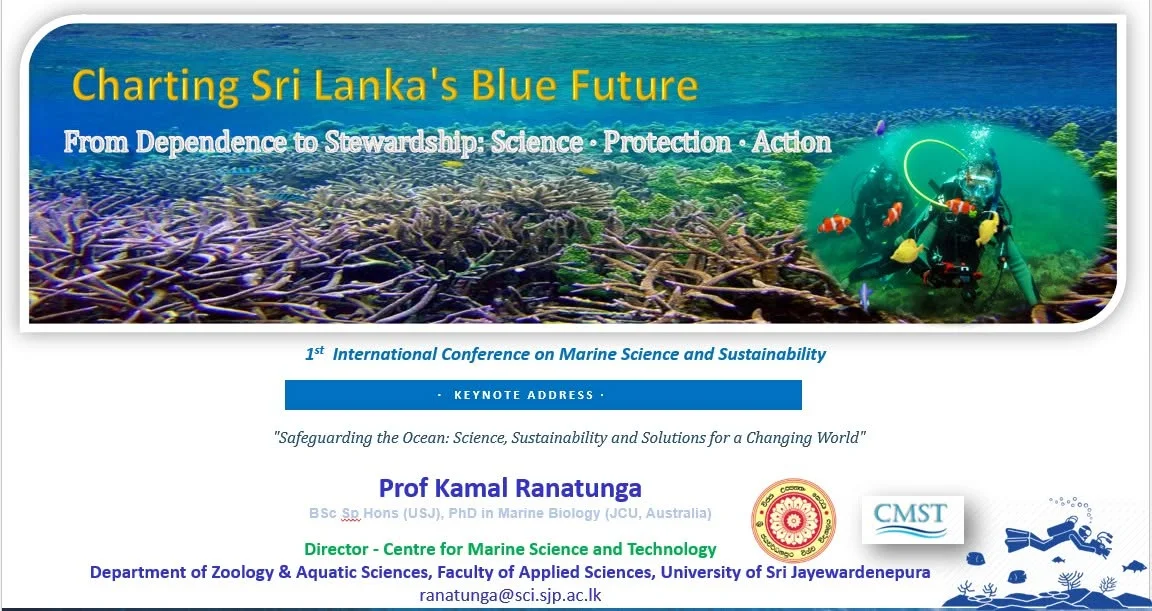
A World Ocean Day keynote examined the urgent pressures facing Sri Lanka's seas, from declining fisheries and damaged coral reefs to maritime disasters, pollution and fragmented ocean governance.
Read Full Article